— 01 · Hair-density research

Density is a measurement, not a promise.

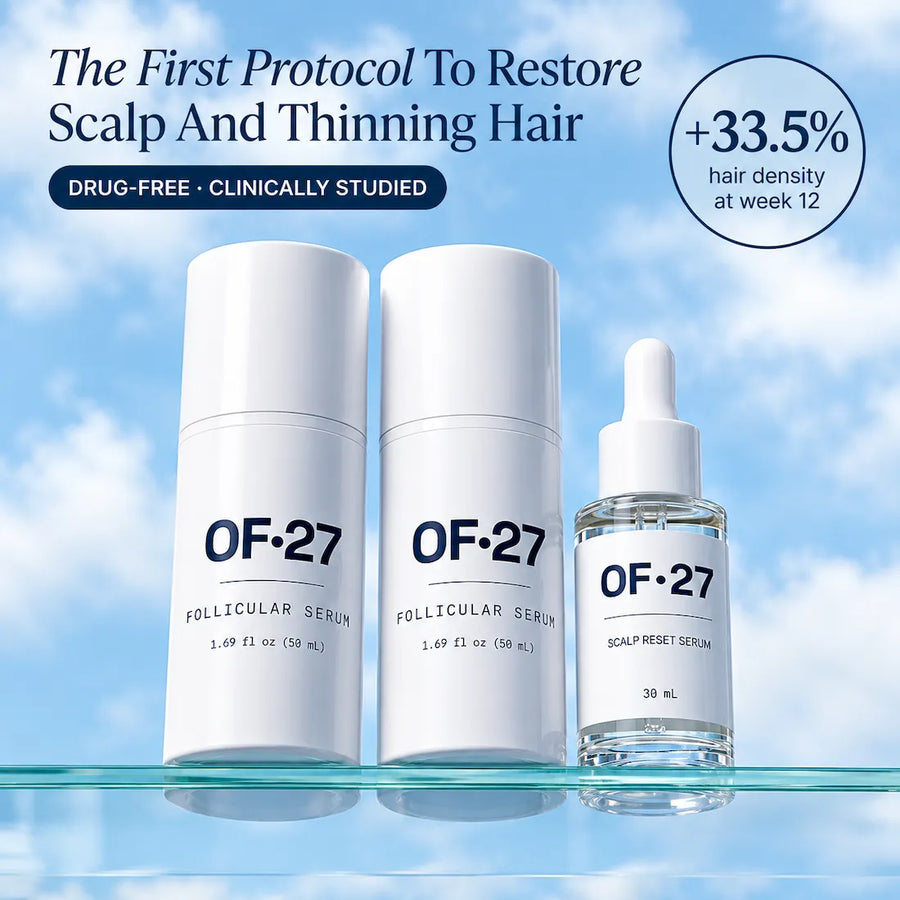
OF·27 stabilises FGF·2 and FGF·7 in a plant-derived oleosome carrier, a daily scalp protocol whose result was reported in a randomised, blind, placebo-controlled study.

Scroll — watch it resolve
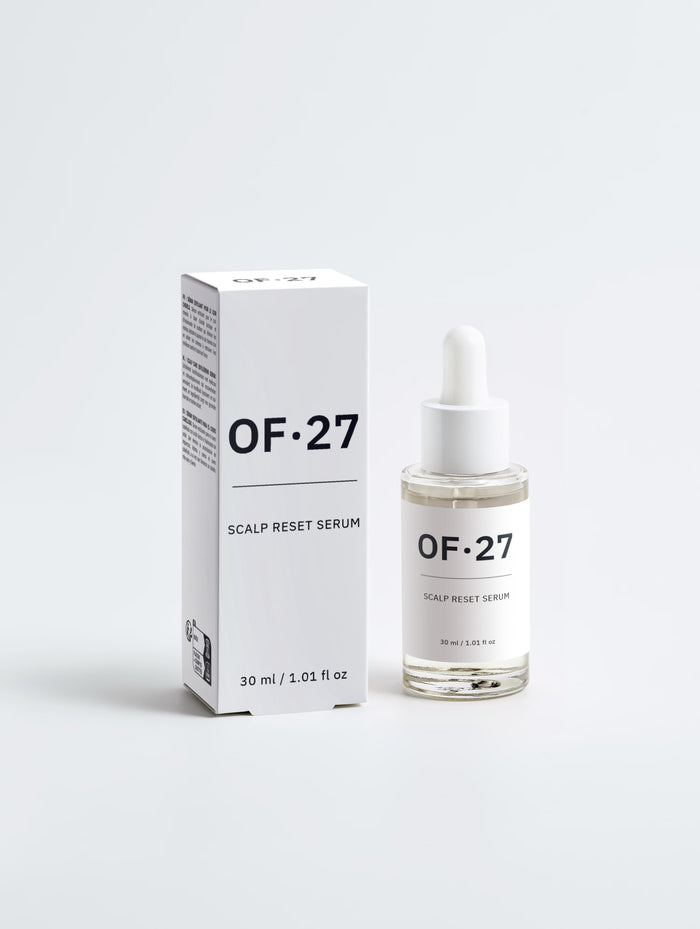
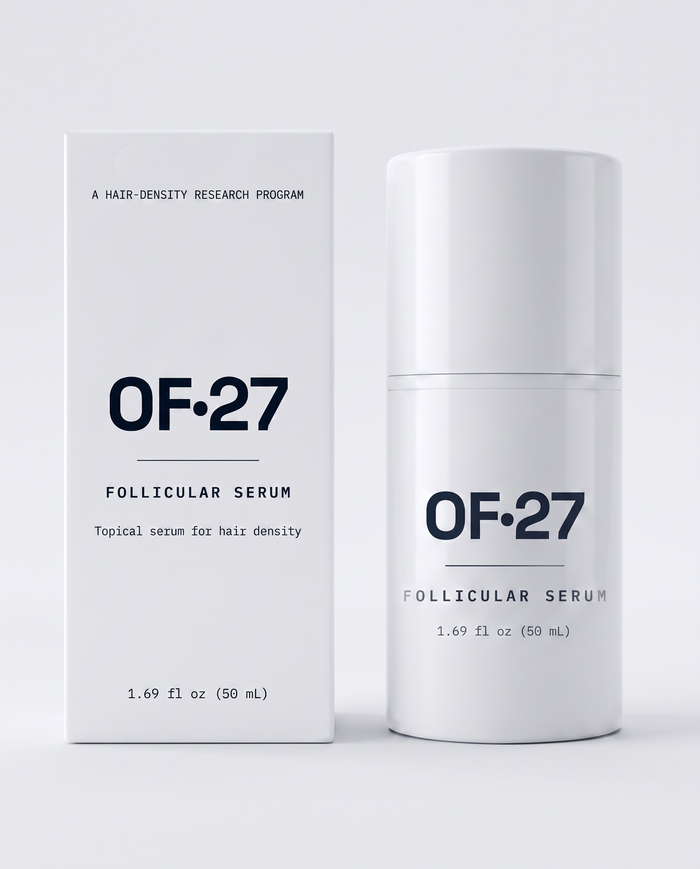
OF·27 follicular serum, 50 mL airless pump bottle
— Specimen · OF·27
50 ML · FGF·2 + FGF·7
— Measured outcomes · vs. baseline
OF·27 serum · n=40
— Hair density
+33.5%
wk 12 · p<0.0001
— Anagen / telogen
+17.0%
wk 12 · p<0.001
— Shaft thickness
+10.6%
wk 12 · p<0.01
— Hydration
+22.2%
wk 12 · p<0.0001

Intra-group change vs. T0 at week 12 · Abich REL/0504/2026 · randomised, blind, placebo-controlled
— 02 · Method, plainly stated
— The program

A research program in hair density, growth, and shaft thickness.

The active

OF·27 is formulated with FGF·2 and FGF·7, two fibroblast growth factors stabilised as oleosome fusions so they reach the follicle intact, the part conventional topical proteins fail at.

• 1

We publish, we don't promise.

An independent study on the active. Report open: Abich REL/0504/2026.

• 2

The protocol is the product.

Not a leave-on serum. A four-week course of a characterised oleosome-protein fusion, with a defined endpoint.

• 3

Stability is the unspoken story.

Keeping two proteins active in a topical is the hard part, named and explained, not marketed.

— 03 · The science

Two signals to the follicle.One plant-derived carrier.

The follicle

The follicle does two things during a healthy growth cycle: it decides when to begin growing, and it builds the hair shaft once it has begun.1 OF·27 supplies one recombinant signal for each step, stabilised by an oleosome.

— Component 01
FGF·2

Fibroblast growth factor 2.

Role: starts the growth phase

A 17 kDa heparin-binding signalling protein. It binds the FGF Receptor on the surface of the dermal papilla, the cell cluster at the base of the follicle that decides when a hair transitions from rest (telogen) to active growth (anagen).2 FGF·2 is the start-work order: without sufficient signal, the transition is delayed and shedding outpaces regrowth.

100 ng/mL · recombinant human · β-trefoil fold
— Component 02
FGF·7

Fibroblast growth factor 7.

Role: builds the hair shaft

A keratinocyte-specific growth factor. It binds the FGF Receptor on the keratinocytes that physically construct the hair shaft, driving their renewal and differentiation.3 If FGF·2 is the start-work order, FGF·7 is the construction instruction: it tells the cells what to assemble once the follicle has committed to growth.

500 ng/mL · recombinant human · keratinocyte-specific
— Component 03
Oleosome

A lipid envelope, plant-derived.

Role: keeps the signals intact

The plant's natural energy-storage organelle: a lipid core surrounded by a single phospholipid layer with oleosin proteins embedded in it. Each growth factor is expressed in the seed as an oleosin fusion; the lipid envelope assembles around the protein during seed development.4 The envelope shields the active protein from the aqueous denaturation that defeats conventional topical growth-factor formulations.5

Carrier · plant-derived · no animal inputs
— Oleosome fusion

Rather than floating free in solution, where they quickly denature, FGF·2 and FGF·7 are expressed as oleosin fusions and displayed on the oil body's phospholipid surface.45 Anchored to the carrier, the growth factors travel intact, ready to signal at the follicle.

— Concentration, retained

A free growth factor loses activity on the way to the follicle, denaturing in solution. Carried inside the oleosome, OF·27's signal holds at the concentration declared on the carton, all the way to the follicle.

— Formulation, declared

Stated concentrations.

FGF·2 concentration
100 ng/mL
FGF·7 concentration
500 ng/mL
Carrier
Plant-derived oleosome
Humectants
glycerin 4% · trehalose 3%
Preservative system
propanediol · 1,2-hexanediol · caprylhydroxamic acid
Texture
xanthan gum 0.3%
pH at 25°C
5.8 ± 0.2
Format
50 mL airless pump bottle
Application
Twice daily · four weeks
Fragrance, silicones
None
Animal-derived inputs
None
— 04 · The clinical study results
40
Volunteers
12
Weeks
4
Parameters
1
Blinded comparison

The full report was issued 02 March 2026 by Abich S.r.l., an ISO 9001 and ISO 13485 certified clinical centre in Italy.
The protocol was randomised, single-blind, placebo-controlled. Volunteers did not know which formulation they were applying.

— Report
ABICH · REL/0504/2026
— Cohort
N=40 · 20 ACTIVE / 20 PLACEBO
— Endpoint
C-CUBE · T84
— Issued
02 / 03 / 2026
— Parameter 01

Hair density

+33.5%

Mean visible hairs per cm², measured by C-CUBE® phototrichogram at T0, T28, T56, T84.

T0T28T56T84
OF·27PLACEBO169.6 · 145.0 hairs/cm²
INTRA-GROUP vs. T0p<0.0001 (****)
— Parameter 02

Anagen / telogen ratio

+17.0%

Proportion of follicles in active growth (anagen) versus resting (telogen). A higher ratio means a greater share of follicles producing hair.

T0T28T56T84
OF·27PLACEBO9.8 · 8.1 A/T
INTER-GROUP at T84p=0.0005 (***)
— Parameter 03

Hair shaft thickness

+10.6%

Mean diameter of visible hair shafts in micrometres (µm), measured by calibrated optical analysis.

T0T28T56T84
OF·27PLACEBO89.0 · 82.2 µm
INTRA-GROUP vs. T0p=0.0027 (**)
— Parameter 04

Scalp condition

+22.2%

Hydration measured by Corneometer® and transepidermal water loss by Nano-Tewameter®, indicators of barrier integrity on the scalp.

HYDRATION+22.2%TEWL−27.2%Mean change vs. baseline · week 12 · OF·27 groupPlacebo: hydration −2.9% (ns) · TEWL −9.2% (ns)
INTER-GROUP at T84p<0.0001 (****)

What we are not claiming.

The study reports a group-mean response. The cohort had a mean density increase of +33.5%; the distribution spans non-responders to high-responders. Individual response will not match the mean.

We are not making a comparative claim against minoxidil, finasteride, or any other named treatment. OF·27 was tested against its own vehicle placebo.

What the study did.

40 healthy female volunteers with telogen effluvium were randomised between active and placebo serum. Investigators measured hair density, anagen/telogen ratio, shaft thickness, scalp hydration and TEWL by C-CUBE® Pixience and Courage-Khazaka instruments at four timepoints over eighty-four days. Volunteers were blinded to the formulation.

— Measured outcomes
Four parameters, one blinded comparison.
ABICH · N=40 · 12 WEEKS
Hover a figure for its meaning
— Hair density
+33.5%
vs. baseline · p<0.0001
— Anagen / telogen
+17.0%
inter-group · p=0.0005
— Shaft thickness
+10.6%
vs. baseline · p=0.0027
— Scalp hydration
+22.2%
inter-group · p<0.0001

— 05 · The protocol

OF·27, a four-week protocol.

One bottle. One four-week course. The shipment arrives sealed; the protocol begins on the day it is opened.

A 50 mL airless pump bottle. One pump in the morning and one at night, over four weeks; each pump delivers a little under 1 mL (about 1 cc), and that is the full dose, no more. Part the hair and apply to the scalp, then massage in for about thirty seconds at the point of application, so the dose reaches the skin, where the follicle sits, rather than resting on the hair. Clear, colorless aqueous solution. Trace plant aroma from the plant-derived oleosome carrier. The airless dispenser keeps the formulation isolated from air and contamination until each dose.

  • — CompositionFGF·2 100 ng/mL · FGF·7 500 ng/mL
  • — CarrierPlant-derived oleosome
  • — Format50 mL airless pump bottle
  • — ApplicationOne pump AM + one PM · four weeks
  • — pH5.8 ± 0.2 at 25°C
  • — StorageRefrigeration recommended · 2–8°C
  • — StandardISO 22716 · cGMP
+33.5% Hair density vs. baseline · week 12 · p<0.0001 · n=40
Placebo +7.2% · Abich REL/0504/2026
— From
$195 / mo
or $255 one-time · 50 mL
Begin the protocol
— Ships from
United States
— Returns
14 days · sealed
— Manufactured
US · ISO 22716
— Four-week protocol 50 ML · AIRLESS PUMP OF·27 hair-density protocol, 50 mL airless pump bottle
In-vitro · exploratory · human dermal papilla cells

Why the signal exists, at the level of the cell.

Before the clinical study, the growth-factor complex was tested on human dermal papilla cells, the cluster at the base of the follicle that governs the growth cycle. Gene expression was read after two days against an untreated control.

— MKI67
×6.5–12

Cell renewal

The marker of actively dividing cells. The clearest signal in the panel: dermal papilla cells entered an active growth state.

— VCAN
×2–5.4

Versican

A marker of dermal-papilla inductivity: the papilla's capacity to instruct a follicle to grow.

— ALPL
×1.4–2.8

Alkaline phosphatase

A standard readout of dermal-papilla activity and the follicle's growth-phase competence.

— VEGFA · FGF2
×~2

Growth-factor signalling

Angiogenic (VEGFA) and growth (FGF2) signalling, each roughly doubled at the higher dose.

— Model
HUMAN DERMAL PAPILLA · 2D MONOLAYER
— Readout
MULTIPLEX qRT-PCR · 48 H
— Reference
NORMALISED TO UNTREATED CONTROL
— Tier
MECHANISTIC · NOT A CLINICAL ENDPOINT

What this is.

Mechanistic, cell-level evidence that the complex engages the hair-growth programme in the dermal papilla. It explains why a density change is biologically plausible; it does not measure one.

What this is not.

Not a clinical result, and not a substitute for one. Hair density on people is reported only in the Results section, from the randomised, placebo-controlled study. Fold-changes are gene expression, not hairs.

— 06 · Frequently asked

Questions, with citations where they exist.

If your question is not answered here, we are reachable at contact@of27bioscience.com. We answer technical questions in plain prose.

What does OF·27 contain?

Two recombinant fibroblast growth factors stabilised in a plant-derived oleosome carrier. The formulation table is published in full; see Note 09 · The study.

Is OF·27 a drug?

No. OF·27 is a topical cosmetic. It has been assessed in an independent clinical study, but it is not a drug and is not intended to treat or prevent any disease, and nothing here is a medical claim.

How was it tested?

A randomised, single-blind, placebo-controlled study, conducted by Abich S.r.l. in Italy between 17 November 2025 and 13 February 2026. Forty healthy female volunteers with telogen effluvium were split equally between active and placebo arms. Volunteers were not told which formulation they were applying.

The active group's mean hair density increased by +33.5% vs. baseline (p<0.0001) at week 12. The placebo group increased by +7.2% (not statistically significant).

ABICH REL/0504/2026 · ISSUED 02/03/2026 · ISO 9001 / ISO 13485

What did the study actually measure?

Four parameters at four timepoints (T0, T28, T56, T84):

Hair density (visible hairs per cm²) by C-CUBE Pixience phototrichogram. Anagen/telogen ratio (proportion of follicles in active growth) by the same device. Hair shaft thickness in micrometres by calibrated optical analysis. Scalp hydration by Corneometer® and transepidermal water loss by Nano-Tewameter®.

Active group changes at week 12: density +33.5%, anagen/telogen +17.0%, shaft thickness +10.6%, hydration +22.2%, TEWL −27.2%. The placebo group did not reach statistical significance on density or anagen ratio.

Will it work for me?

The study reports a group-mean response of +33.5%. The individual distribution spans non-responders to high-responders. Note 09 · The study lists the inclusion criteria (healthy female volunteers experiencing telogen effluvium) so a reader can compare her situation to the cohort.

We do not extrapolate from a group mean to a personal prediction.

How is it different from minoxidil or finasteride?

Minoxidil is a small-molecule vasodilator applied topically. Finasteride is a 5-alpha reductase inhibitor (typically oral, prescription). OF·27 is neither. It is a topical containing recombinant growth factor proteins that signal to follicle cells through a different mechanism.

The three are not direct substitutes. The study does not make a comparative claim against either.

What is an oleosome?

A plant-derived lipid body. Certain oilseeds naturally produce them as energy storage. When a growth factor protein is expressed in the seed alongside an oleosome, the two fuse during seed development.

The fused complex survives extraction, formulation, and the journey from bottle to scalp at concentrations the formulation declares. Proteins denature in solution; the oleosome lipid envelope stabilises them.

What is the protocol exactly?

One 50 mL airless pump bottle. One pump in the morning and one at night, applied directly to the scalp (not the lengths), for four weeks. Each pump delivers a little under 1 mL (about 1 cc), and that is the full dose, no more. The airless dispenser keeps each dose isolated from air until application.

The published twelve-week primary endpoint is reached by completing three consecutive four-week courses.

How should I store it?

We recommend refrigerating OF·27 at 2 to 8 °C. The actives are biologics, and cold storage best preserves their activity across the four-week course, so it is the conservative choice rather than a strict requirement. The formulation tolerates room temperature without harm, whether during application or in transit; where convenient, return the bottle to the fridge after use.

Do not freeze. Freezing ruptures the oleosome carrier and irreversibly denatures the proteins. A bottle that has frozen should not be used.

Are growth factors safe in a topical?

FGF·2 and FGF·7 have been studied in dermatology and wound healing for decades; recombinant forms are present in approved wound-care products. The Abich study recorded the formulation against vehicle placebo over twelve weeks under medical supervision.

Volunteers were screened for irritated skin, active dermatological pathology, and recent topical medication. No serious adverse events were reported during the trial.

Can men use it?

The Abich study cohort was all-female (n=40), recruited specifically for telogen effluvium. We do not yet have male-cohort data and will not extrapolate. A separate male-cohort study is in planning.

Where is it manufactured?

In the United States, under ISO 22716 (cosmetic GMP). Each bottle carries a batch identifier, manufacturing date, and expiry.

Can I use it alongside my other haircare?

Yes. Apply to a clean, towel-dried scalp before any other leave-in product. The formulation absorbs in under sixty seconds and does not interact with shampoos, conditioners, or styling products.

If you are using a prescribed topical (minoxidil, prescription steroids), discuss the addition with your dermatologist.

Is it tested on animals?

No. The clinical study cohort was human. Pre-clinical work used in vitro hair follicle organ culture, not animal models.

How can I read the full study?

The study is published in full and peer-reviewed. Read it in the peer-reviewed journal International Journal of Clinical & Experimental Dermatology(IJCED) ↗. It sets out the protocol, the cohort criteria, the endpoint definitions, the results tables, the statistical significance summaries, and the adverse-event record. For a plain-language walkthrough, see Note 09 · The study.

Funding disclosure: this efficacy study was published by Core Biogenesis, the supplier of the active ingredient.

— 07 · About

About the program.

OF·27 is an independent hair-density research program. It is built on two fibroblast growth factors, FGF·2 and FGF·7, stabilised as oleosome fusions and formulated into a four-week scalp protocol. We report the evidence rather than describe a benefit.

The program operates like a publication. The methodology document — Note 09 · The study — is the primary asset; the product is what carries the protocol forward. We publish, we don't promise. For a methodological question, OF·27 is reachable at contact@of27bioscience.com, answered in plain prose.

— The active

A stability problem, solved in the seed.

Growth factors are signaling proteins. In topical application their challenge has always been the same: proteins denature in aqueous solution. The active concentration on the scalp, twenty minutes after application, is rarely the concentration that was formulated.

The active in OF·27 is supplied by Core Biogenesis, a French biotechnology company, which solved this in the seed. Its platform expresses each growth factor inside Camelina sativa alongside an oleosome, a lipid body the plant already produces for energy storage. The two fuse during seed development, and the fused complex survives extraction, formulation, and the journey from bottle to scalp at the concentrations the formulation declares.

— The discipline

Publication before persuasion.

Every external claim is cited. The clinical study on the active is independent, its methodology is open, and the report identifier is reservable for citation in other work.

The voice is sentence case. The headlines do not use comparative adjectives. The bottle carries a batch identifier. The visual register is that of a research program: clinical, institutional, documentary.

— Program
OF·27 · OLEOSOME FACTOR 2·7
— Active supplied by
CORE BIOGENESIS · FRANCE
— Standard
NF EN ISO 22716
— Operated by
OF27 BIOSCIENCE LLC
— Contact
contact@of27bioscience.com
— Methodology
— Issued by
The OF·27 research program
Operated by OF27 Bioscience LLC · May 2026
— Notes

Hair science, in your inbox.

Notes from the laboratory as the work moves: what we are measuring, what we are reading, what the reviewers are asking. Science only.

— Methodology
Updates as the dataset extends.
— Peer review
Excerpts from the review record.
— Batch notes
Production and formulation detail.
— Correspondence
The occasional letter to a reviewer.
— Subscribe
You're on the list.

Thank you. The next note from the laboratory will reach you at the address you entered.

No promotions, no discounts, no urgency. Nothing else.
One-click unsubscribe, always.
— 08 · References

References.

The works below substantiate the mechanistic and biological claims made on this page: the roles of FGF·2 and FGF·7 in the hair follicle, the structure of the growth cycle, and the principle of carrying proteins on plant oil bodies. They do not report on OF·27 itself — the clinical outcomes shown above are from the Abich study (REL/0504/2026), cited in full in the Results section.

  1. Schneider, M. R.; Schmidt-Ullrich, R.; Paus, R.
    The hair follicle as a dynamic miniorgan.
    Current Biology, 19(3), R132–R142, 2009.
    doi.org ↗
  2. Rosenquist, T. A.; Martin, G. R.
    Fibroblast growth factor signalling in the hair growth cycle: expression of the fibroblast growth factor receptor and ligand genes in the murine hair follicle.
    Developmental Dynamics, 205(4), 379–386, 1996.
    NCBI ↗
  3. Guo, L.; Degenstein, L.; Fuchs, E.
    Keratinocyte growth factor is required for hair development but not for wound healing.
    Genes & Development, 10(2), 165–175, 1996.
    doi.org ↗
  4. van Rooijen, G. J. H.; Moloney, M. M.
    Plant seed oil bodies as carriers for foreign proteins.
    Bio/Technology, 13(1), 72–77, 1995.
    doi.org ↗
  5. Wang, W.
    Instability, stabilization, and formulation of liquid protein pharmaceuticals.
    International Journal of Pharmaceutics, 185(2), 129–188, 1999.
    doi.org ↗